
gambling/rtp: Difference between revisions
More actions
No edit summary Tags: mobile web edit mobile edit |
No edit summary Tags: mobile web edit mobile edit |
||
| (7 intermediate revisions by the same user not shown) | |||
| Line 5: | Line 5: | ||
For example, if a casino game has a 96% RTP, it is designed to collectively return $96 in winnings for every $100 wagered by all players. The remaining 4% is the "house edge", which is the casino's built-in profit margin. | For example, if a casino game has a 96% RTP, it is designed to collectively return $96 in winnings for every $100 wagered by all players. The remaining 4% is the "house edge", which is the casino's built-in profit margin. | ||
It is important to understand that RTP is a statistical average calculated over millions of rounds. It does not guarantee that an individual player will win back $96 from a $100 session, as short-term results are highly random. | It is important to understand that RTP is a statistical average calculated over millions of rounds. It does not guarantee that an individual player will win back $96 from a $100 session, as short-term results are highly random. RTP is verified by independent testing labs, such as eCOGRA and iTech Labs. | ||
=== How does the Return to Player (RTP) work? === | === How does the Return to Player (RTP) work? === | ||
If a game has an RTP of 96%, it is designed to collectively return $96 in winnings for every $100 wagered by all players. The remaining $4 (or 4%) is the house edge that ensures the casino generates a profit. RTP is calculated by dividing the total amount of money won by players by the total amount of money gambled. | If a game has an RTP of 96%, it is designed to collectively return $96 in winnings for every $100 wagered by all players. The remaining $4 (or 4%) is the house edge that ensures the casino generates a profit. RTP is calculated by dividing the total amount of money won by players by the total amount of money gambled. | ||
| Line 20: | Line 20: | ||
| Availability || Mostly online || Physical machines and progressive jackpot games | | Availability || Mostly online || Physical machines and progressive jackpot games | ||
|} | |} | ||
== Why does payback (RTP) matter in online casinos? == | == Why does payback (RTP) matter in online casinos? == | ||
For players, RTP acts as a guide for bankroll management and game selection. A higher RTP means the game is mathematically programmed to return a larger percentage of wagered money over time, theoretically extending a player's gaming session and giving them better long-term value for their deposits. Experienced gamblers actively look for high-RTP games to maximize their odds of winning or sustaining their bankroll. | For players, RTP acts as a guide for bankroll management and game selection. A higher RTP means the game is mathematically programmed to return a larger percentage of wagered money over time, theoretically extending a player's gaming session and giving them better long-term value for their deposits. Experienced gamblers actively look for high-RTP games to maximize their odds of winning or sustaining their bankroll. | ||
| Line 25: | Line 26: | ||
For the casino, RTP is the mechanism that guarantees their profit. | For the casino, RTP is the mechanism that guarantees their profit. | ||
=== The Difference Between RTP and House Edge === | === The Difference Between RTP and House Edge === | ||
[[File:RTP-and-house-edge-difference.png|link=|width=100%|alt=difference between RTP and house edge]] | |||
They are two expressions of the same value, stated from opposite perspectives: | They are two expressions of the same value, stated from opposite perspectives: | ||
* RTP — what the player gets back (player's perspective) | * RTP — what the player gets back (player's perspective) | ||
| Line 37: | Line 40: | ||
Neither metric changes based on previous results. Each spin is independent. | Neither metric changes based on previous results. Each spin is independent. | ||
== What is a good RTP for slots? == | == What is a good RTP for slots? == | ||
{| class="wikitable" | {| class="wikitable" | ||
| Line 49: | Line 51: | ||
|} | |} | ||
== How to calculate return to player (RTP)== | == How to calculate return to player (RTP)== | ||
[[File:gambling-rtp-formula.png|alt=rtp formula in gambling]] | [[File:gambling-rtp-formula.png|link=|width=100%|alt=rtp formula in gambling]] | ||
To calculate the Return to Player (RTP), you divide the total amount of money won by players by the total amount of money they wagered, and then multiply by 100 to get a percentage.<ref>https://www.gamblingcommission.gov.uk/licensees-and-businesses/guide/page/how-to-calculate-return-to-player-rtp</ref> | To calculate the Return to Player (RTP), you divide the total amount of money won by players by the total amount of money they wagered, and then multiply by 100 to get a percentage.<ref>https://www.gamblingcommission.gov.uk/licensees-and-businesses/guide/page/how-to-calculate-return-to-player-rtp</ref> | ||
| Line 127: | Line 129: | ||
|} | |} | ||
{{CTA|text=RTP is a theoretical figure calculated over millions of spins, so it reflects long-term game behavior rather than short-term results.<br>It does not guarantee profit in a single session, and players can still lose money in the short run.}} | |||
== References == | == References == | ||
{{DISPLAYTITLE:The RTP meaning in Gambling}} | {{DISPLAYTITLE:The RTP meaning in Gambling}} | ||
Latest revision as of 09:42, 20 March 2026
RTP (Return to Player) is the percentage of total wagered money a slot or casino game statistically pays back to players over time.[1]
What does RTP mean in Gambling?
Return to Player (RTP) is a metric used in gambling to show the percentage of all wagered money a specific game is programmed to pay back to players over the long term.
For example, if a casino game has a 96% RTP, it is designed to collectively return $96 in winnings for every $100 wagered by all players. The remaining 4% is the "house edge", which is the casino's built-in profit margin.
It is important to understand that RTP is a statistical average calculated over millions of rounds. It does not guarantee that an individual player will win back $96 from a $100 session, as short-term results are highly random. RTP is verified by independent testing labs, such as eCOGRA and iTech Labs.
How does the Return to Player (RTP) work?
If a game has an RTP of 96%, it is designed to collectively return $96 in winnings for every $100 wagered by all players. The remaining $4 (or 4%) is the house edge that ensures the casino generates a profit. RTP is calculated by dividing the total amount of money won by players by the total amount of money gambled.
Pros and cons of playing high RTP slots vs. low RTP slots
| High RTP (97%+) | Low RTP (below 94%) | |
|---|---|---|
| Statistical return | Better long-run return | Higher house edge |
| Session longevity | Bankroll depletes slower on average | Bankroll depletes faster on average |
| Jackpot potential | Often smaller; prizes fund the RTP | May include large jackpots |
| Availability | Mostly online | Physical machines and progressive jackpot games |
Why does payback (RTP) matter in online casinos?
For players, RTP acts as a guide for bankroll management and game selection. A higher RTP means the game is mathematically programmed to return a larger percentage of wagered money over time, theoretically extending a player's gaming session and giving them better long-term value for their deposits. Experienced gamblers actively look for high-RTP games to maximize their odds of winning or sustaining their bankroll.
For the casino, RTP is the mechanism that guarantees their profit.
The Difference Between RTP and House Edge
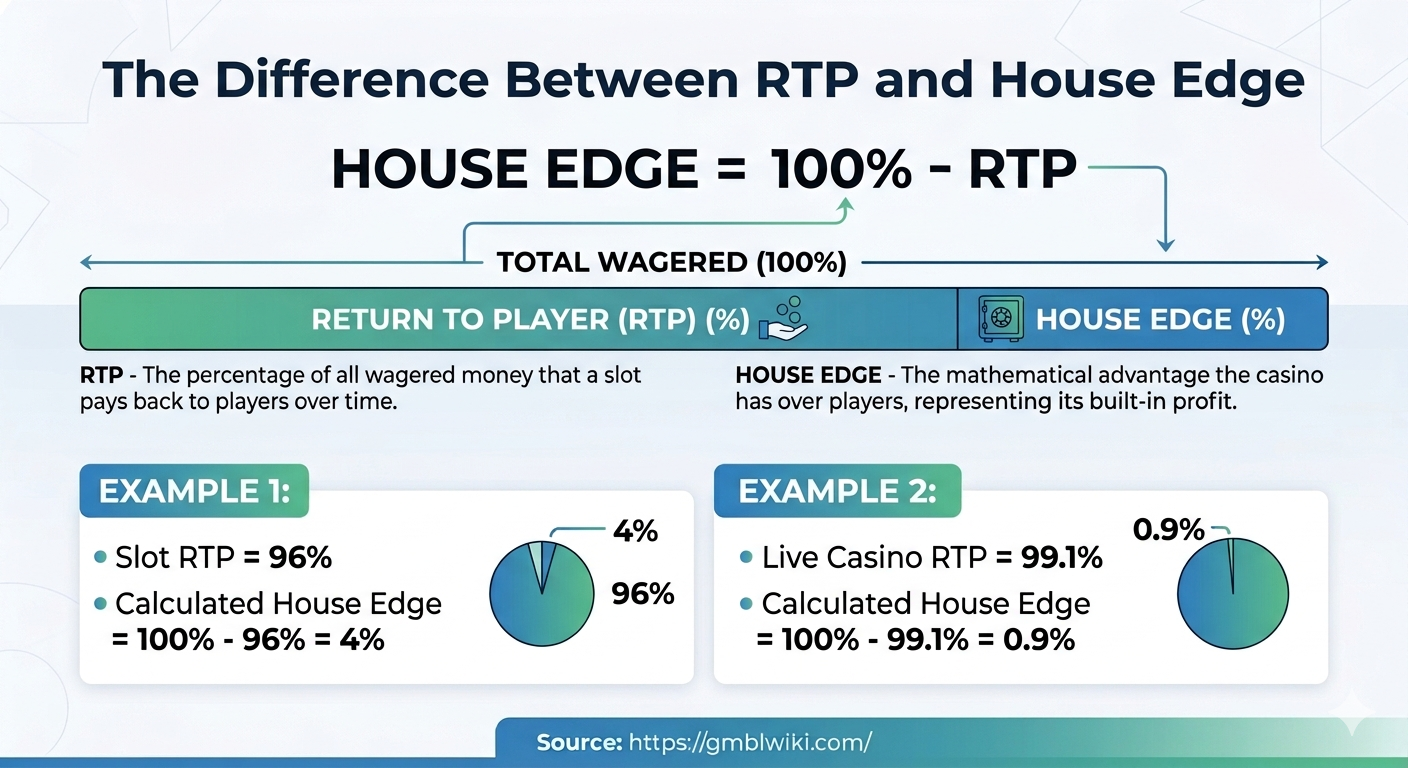
They are two expressions of the same value, stated from opposite perspectives:
- RTP — what the player gets back (player's perspective)
- House Edge — what the casino keeps (operator's perspective)
| Metric | Formula | Example (96% RTP game) |
|---|---|---|
| RTP | Payout ÷ Total wagered | 96% |
| House Edge | 100% − RTP | 4% |
Neither metric changes based on previous results. Each spin is independent.
What is a good RTP for slots?
| Category | RTP Range |
|---|---|
| Low | Below 94% |
| Medium | 94 - 96% |
| High | 97% and above |
How to calculate return to player (RTP)
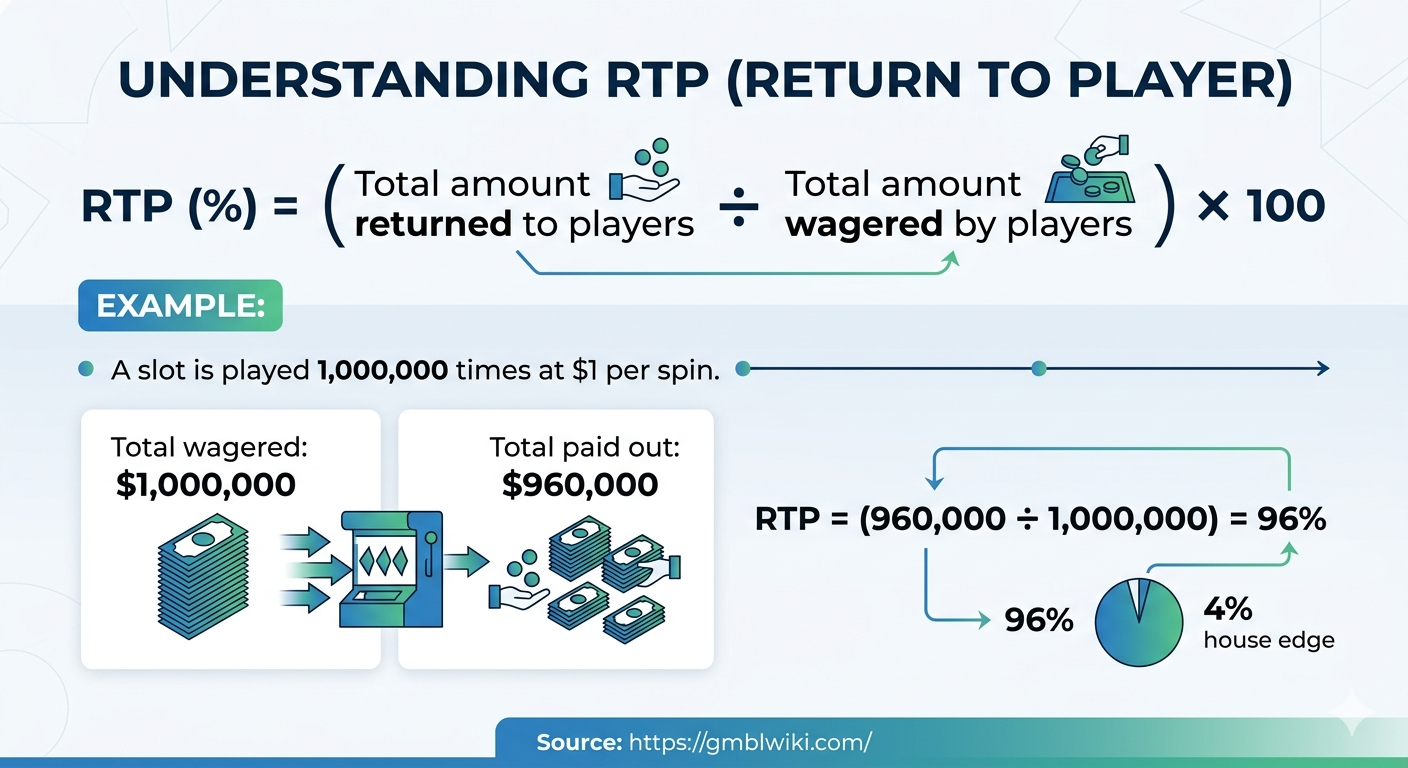
To calculate the Return to Player (RTP), you divide the total amount of money won by players by the total amount of money they wagered, and then multiply by 100 to get a percentage.[2]
The formula is:
RTP (%) = (Total amount returned to players ÷ Total amount wagered by players) × 100
Example:
A slot is played 1,000,000 times at $1 per spin. Total wagered: $1,000,000. Total paid out: $960,000.
RTP = (960,000 ÷ 1,000,000) × 100 = 96%
The formula above is used by regulators and casinos to calculate the actual RTP over a specific period of time to ensure the game is performing as designed.[3]
How to find the RTP on a slot machine?
| Source | How to Access |
|---|---|
| In-game | Open the info or paytable menu ("i" button, "?" icon, or Rules tab) |
| Casino website | Game detail pages or dedicated RTP tables |
| Developer website | Software providers (NetEnt, Pragmatic Play, Play'n GO, etc.) publish RTP for every title |
| Casino databases | SlotCatalog and other websites maintain public game data[4] |
What is the best slot win percentage?
The industry standard for average online slots sits between 95% and 96%, making anything above 96% a mathematically better choice for players.[5]
High RTP slots
| Game | Developer | RTP |
|---|---|---|
| Moody Fruits | Relax Gaming | 99.91%[6] |
| Golden Kick | StakeLogic | 99.62%[7] |
| Stone Hominid | Dragoon Soft | 99.95%[8] |
| Greatest Circus | Dragoon Soft | 99.54%[9] |
| Dragoon Soft | Dragoon Soft | 99.54%[10] |
RTP and Volatility
Return to Player (RTP) and volatility (variance) are two distinct mathematical metrics that work together to determine the payout behavior of casino games. RTP indicates how much money a game will return over the long term, whereas volatility determines exactly how those funds will be distributed during a gaming session.[11]
| Combination | Payout frequency | Win size | Best for | Bankroll risk |
|---|---|---|---|---|
| High RTP + Low Volatility | Very frequent | Small wins, often below the stake | Players who want longer playtime and steadier balance | Lowest |
| High RTP + High Volatility | Infrequent, with long losing streaks possible | Bigger wins | Players chasing large payouts and who can handle variance | High |
| Low RTP + Low Volatility | Frequent | Very small wins | Casual players focused more on entertainment than value | Medium |
| Low RTP + High Volatility | Very infrequent | Large but rarer wins | Players willing to risk losing the deposit quickly | Highest |

It does not guarantee profit in a single session, and players can still lose money in the short run.
References
- ↑ https://en.wikipedia.org/wiki/Return_to_player
- ↑ https://www.gamblingcommission.gov.uk/licensees-and-businesses/guide/page/how-to-calculate-return-to-player-rtp
- ↑ https://gaminglabs.com/services/igaming/game-mathematics-percentage-return-to-player-rtp-analysis/
- ↑ https://slotcatalog.com/
- ↑ https://www.oddschecker.com/us/casino/guides/what-rtp-volatility-mean-slots
- ↑ https://slotcatalog.com/en/slots/Moody-Fruits
- ↑ https://slotcatalog.com/en/slots/golden-kick-stakelogic
- ↑ https://slotcatalog.com/en/slots/Stone-Hominid
- ↑ https://slotcatalog.com/en/slots/Greatest-Circus
- ↑ https://slotcatalog.com/en/slots/Maya-King
- ↑ https://www.softswiss.com/knowledge-base/rtp-igaming-faq/